

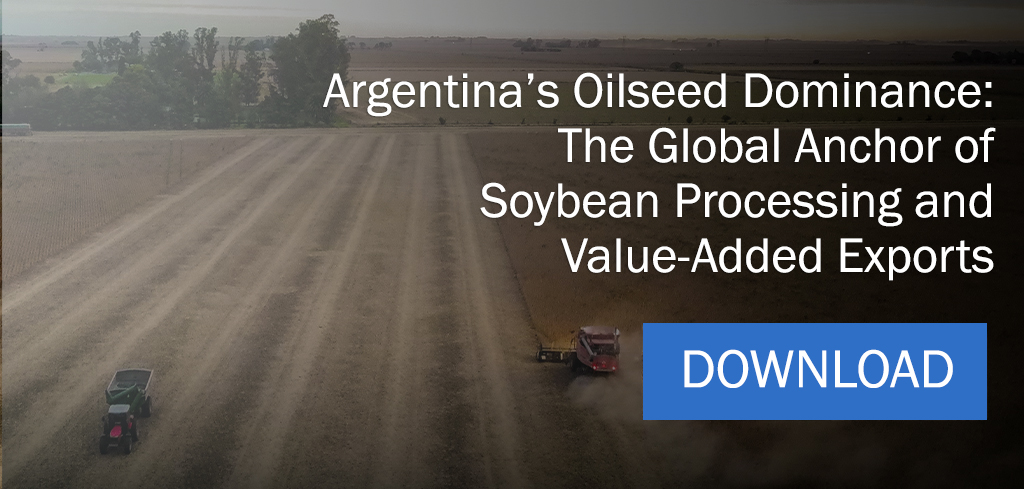
Argentina plays an important role in the global oilseed industry. As the world’s third largest soybean producer and leading exporter of value-added soy oil and meal products, the country has carved out a reputation as a processing powerhouse—establishing the dominance of the Argentina soybean crush sector.
Home to one of the world’s largest and most highly developed soybean processing markets, the Argentina soybean crush corridor has capacity to process 67 million metric tons (MMT) of material every year. Yet despite the unmatched scale of its crushing infrastructure, Argentina consistently operates below full capacity, with much of its domestic supply held up in stock or diverted to the export market instead of feeding domestic processing plants.
These contrasting dynamics create a market paradox where potential scale and growth are limited by persistent underutilization. Let’s take a closer look at the logistical inefficiencies and production constraints that keep Argentina from realizing its full crush potential.
Argentina soybean production stats
Soybeans cover 16.5 million hectares of farmland in Argentina, producing just shy of 50 MMT per year. Although soybean output remains strong enough to secure Argentina’s spot among the world’s top three producers, behind Brazil and the United States, production is influenced by a few key factors:
- Farmers frequently rotate between soy- and corn-dominant crop cycles, based on expected prices and conditions. For example, after a soy-heavy season in marketing year 2024/25 driven by pest pressures in corn, Argentina soybean production is expected to decline slightly in MY2025/26 as producers shift back to corn
- Argentina produces two soybean crops per year. About 70% of the harvest comes from the first soy crop, harvested during April and May, and the balance comes from a second crop, which follows the winter wheat harvest into early July. Extreme weather conditions—like the initial drought in January 2025 followed by excessive rains in late February and early March—can threaten expected yields under this double-cropping model.
- The majority (75%) of Argentina’s soybeans are produced on rented land. As rents increase, alongside other rising production costs, the profit margins for soybean farming are shrinking—forcing many farmers to hold stocks in on-farm storage and delay sales in anticipation of improved prices or policies. Many farmers only sell enough soybeans during the marketing year to break even.
Despite shrinking production margins and competing crop rotations, Argentina’s soybean sector maintains steady output levels from year to year. But where this supply ends up is what creates the paradox.
Argentina soybean crush capacity
With a highly developed soybean processing infrastructure, the Argentina soybean crush sector has the capacity to process far more material than the country can produce. Roughly 80% of the Argentina soybean crush capacity is concentrated along the Paraná River in the Santa Fe province, giving processing plants direct access to deepwater ports for exporting value-added meal and oil and importing raw beans from other top-producing countries upstream.
In fact, it’s more cost effective for processors along the Argentina soybean crush corridor to import raw beans from other countries, like Paraguay, than to transport domestic beans from southern production zones outside of the primary processing belt. These southern-grown beans generally contain less protein, making them better suited to foreign export markets than the high standards of the Argentina soybean crush market.
Additionally, recent reductions in soybean export duties are making Argentina soybean exports even more cost-effective. However, booming Argentina soybean exports have slowed the supply to domestic processors, creating a paradox in the local market by making Argentina one of the few top-producing countries that’s also a net importer of raw beans, with imports reaching nearly 7 MMT annually.
Supplemented by imported beans to fill the gap in domestic supply, Argentina ranks as the world’s leading producer of soybean meal (with production near 33 MMT) and oil (with production of nearly 8.5 MMT). The vast majority of these value-added products are exported, anchoring Argentina’s export-oriented status.
Untapped growth potential
Although a significant share of the Argentina soybean crush sector sits idle, even during strong production years, the industry is poised to scale up operations. However, a few key challenges must be solved in order for the country to reach its full crush potential.
1. Supply chain alignment
The disconnect between where soybeans are produced and where they’re processed creates inefficiencies across Argentina’s supply chain. By aligning production and crush through improved logistics and vertically integrated sourcing, Argentina’s soybean sector can reduce its exposure to supply variability and its dependence on imports.
2. Operational flexibility
Although soybeans dominate Argentina’s oilseed sector, specialty crops like sunflower seeds and peanuts play important supporting roles. Unlike soybean, for example, nearly all of the 4 MMT tons of sunflower seeds grown in Argentina are crushed domestically in specialized processing facilities located near key growing regions—producing premium sunflower seed oil and meal for export markets.
Since most Argentina soybean crush facilities are designed to process soybeans exclusively, investing in flexible extraction systems that can process a variety of oilseeds can provide an operational advantage, enabling processors to:
- Maintain production even when soybean availability is limited
- Capitalize on emerging markets with premium specialty products
- Enhance overall plant efficiency and productivity
By bridging the gap between oilseed availability and underutilized crush capacity, processors in Ardentina can significantly increase output without expanding existing infrastructure.
In a market defined by its unmatched scale and untapped capacity, processors equipped to process soybeans and other seeds efficiently and economically can unlock the full capacity of Argentina soybean crush.