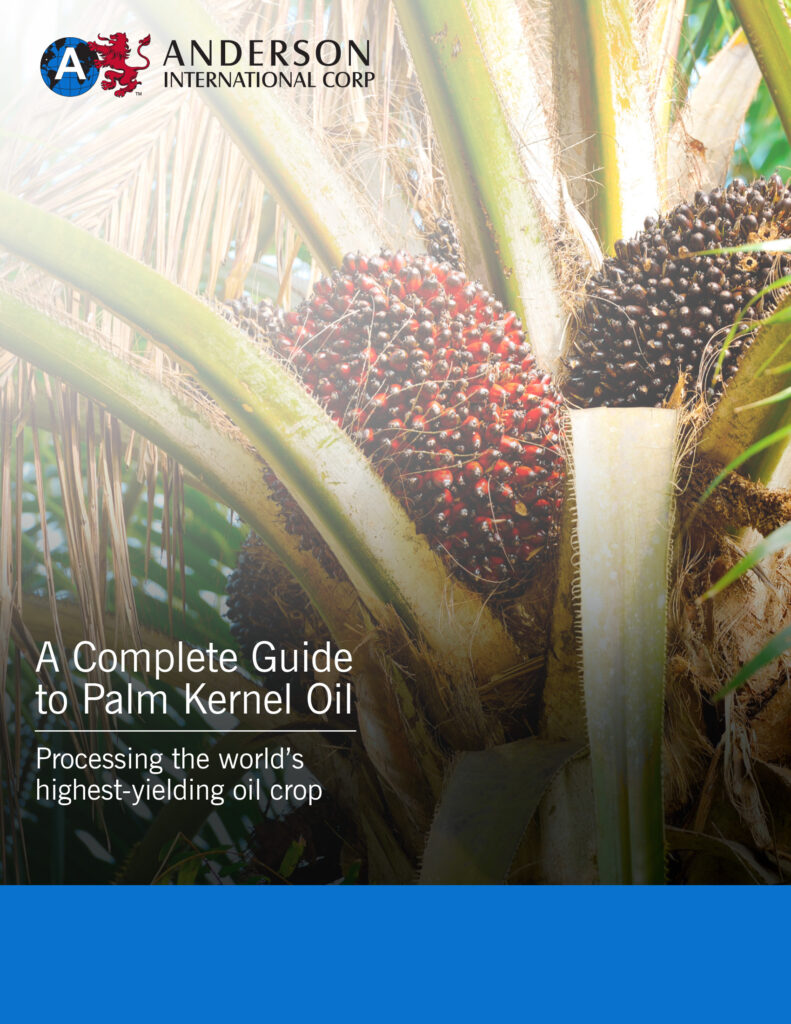
What’s Inside the eBook
This guide explores the history of oil palm production, the rapid rise in global demand, how each oil is processed, and the key differences between palm oil and palm kernel oil.

Oil palms grow in tropical regions around the world. After three years, these trees start producing clusters of oil-rich fruit called fresh fruit bunches (FFB). Plantation workers hand-pick these bunches, which typically weigh between 20 and 50 pounds each, containing up to 3,000 individual fruitlets.

The solid residue discharged from the palm oil press is a mixture of de-oiled fiber and palm nuts, which contain oil-rich kernels that can also be pressed to extract a different type of oil. The palm nut—a byproduct of palm oil production—is typically processed to varying facilities than whole palm fruits.
Palm oil, extracted from the fruit of the oil palm tree, boasts a balanced 50/50 ratio of saturated and unsaturated fatty acids. It contains 40% oleic acid (monounsaturated fatty acid), 10% linoleic acid (polyunsaturated fatty acid), 45% palmitic acid, and 5% stearic acid (both saturated fatty acids).