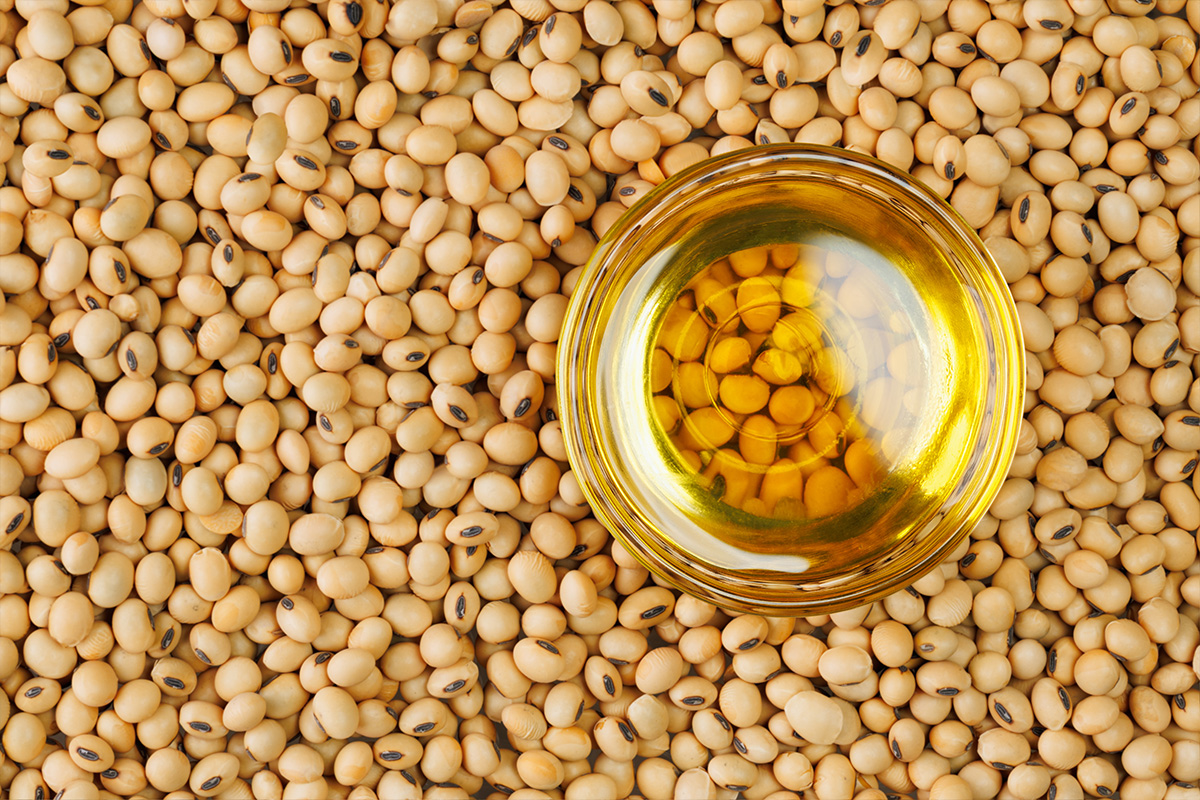
Soybean oil dominates food, feed, and industrial markets around the world, comprising nearly a third of global vegetable oil production. Although its widespread availability and relatively lower price make it popular across various applications, conventional soybean oil also comes with major drawbacks. As market demand shifts away from partially hydrogenated oil toward healthier fats, high oleic soybean oil is rapidly gaining traction as a premium alternative to commodity soy.
Here’s a quick breakdown of the benefits fueling the demand for this premium product, along with the challenges and opportunities facing U.S. processors.
What is high oleic soybean oil?
Conventional soybean oil typically contains more than 50% linoleic acid and 7% linolenic acid. This high concentration of polyunsaturated fatty acids minimizes the oxidative and thermal stability of soybean oil, reducing its shelf life and causing it to break down when exposed to high heat. To improve these traits, soybean oil is partially hydrogenated—a process that creates trans fats, which can raise LDL (“bad”) cholesterol and lower HDL (“good”) cholesterol, increasing the risk of heart disease and other health issues.
As consumers and food processors look to avoid unhealthy trans fats, high oleic soybean oil offers a healthier alternative. Produced from soybeans specifically bred with a higher concentration of monounsaturated fatty acids (at least 70% oleic acid), high oleic soybean oil contains a lower concentration of saturated and polyunsaturated fats (less than 10% linoleic and 3% linolenic acids).
This favorable fatty acid profile gives high oleic soybean oil several functional benefits over conventional soybean oil:
- Improved stability that resists oxidation and withstands high temperatures without hydrogenation, lasting 2-3 times longer than standard vegetable oils.
- Enhanced performance in frying applications, with reduced polymer build-up on cooking surfaces.
- Extended shelf life that allows high oleic soybean oil to be stored 2-3 times longer than conventional soybean oil.
- Elimination of preservatives typically added to conventional soybean oil to control oxidation and extend shelf life.
- Enriched health benefits that can reduce the risk of coronary heart disease compared to oils high in saturated fats.
Beyond its explosive demand in food applications, high oleic soybean oil also offers benefits for livestock feed formations—where it improves milk fat yield in dairy rations—and industrial applications, where it’s used in the production of asphalt polymers, biobased plastics, and environmentally-friendly hydraulic fluids.
These broad benefits position high oleic soybean oil alongside other premium specialty oils, while leveraging the scale and familiarity of traditional soy.
Growth potential of high oleic soybean oil
Since it was first commercialized in 2012, high oleic soybean oil production has accelerated across 16 states. Recent planted acreage exceeded 1 million acres, with projections from the United Soybean Board and U.S. Soybean Export Council predicting that planted acreage could triple over the next five years.
On the farm, high oleic soybeans offer several key advantages:
- Comparable yields at least as good as—or even better than—average yields of conventional soybeans.
- Similar agronomic performance using the same inputs, disease controls, planting and harvesting equipment as conventional soybeans.
- Premium market opportunity with processors offering farmers $1-$2 or more per bushel over standard soybean prices.
Once processed, high oleic soybean oil often commands prices $0.10 to $0.20 higher per pound above commodity soybean oil prices—and nearly 2-3 times more than that for expeller-pressed non-GMO high oleic soybean oil.
Although the advantages for farmers and processors are clear, scaling production of any emerging specialty crop involves several logistical challenges. While the supply chain infrastructure supporting high oleic soybean oil processing rapidly matures in regions where the production of premium U.S. soy is concentrated—particularly in Ohio and Indiana—the local processing capacity in other areas will have to keep pace with projected growth as high oleic soybean production expands into new markets across the country.
The path toward premium U.S. soy
For U.S. oilseed processors, high oleic soybean oil offers a pathway beyond commodity margins toward increased profitability, stronger global competitiveness, and diversified market potential. Processors that are equipped to capitalize on this niche will be able to tap into:
- Premium pricing driven by enhanced end-user value
- Compatibility with existing soybean processing infrastructure
- Projected production growth and supply chain maturity across the U.S.
Anderson International’s industry-leading oilseed processing equipment positions processors to capture the upside of premium soy. By leveraging Anderson’s energy-efficient mechanical presses to preserve the unique fatty acid profile of these specialty soybeans, processors can maximize oil yields, product quality, and ultimately, profitability as the demand for high oleic soybean oil accelerates.
Want to learn more? Contact a rep today.