Nearly a century after it first turned heads at the 1933 Chicago World’s Fair, a small-but-mighty screw press is making a big comeback at Anderson International. While some machines make history, this pilot-scale expeller press is still writing it by taking on a new role in R&D.
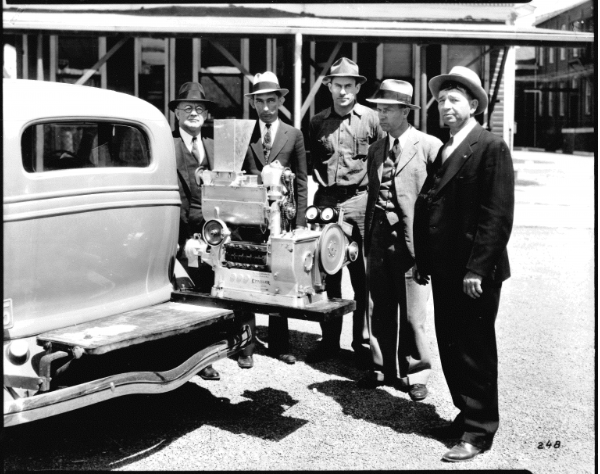
Built in 1930 as one of only four Mini Expellers ever produced, this compact expeller press was originally designed to demonstrate Anderson’s revolutionary oil extraction technology to potential customers. Now, after being carefully reassembled at Anderson’s pilot plant in Stow, Ohio, this mini machine is once again doing what it was built to do: proving what’s possible in processing.
Here’s how this almost-antique pilot-scale expeller press is helping oilseed processors anticipate the next generation of innovation.
The history of the Mini Expeller® Press
When Valerius D. Anderson filed a patent for his invention in 1900, Anderson’s Expeller® made history as the first continuous screw press—enabling more efficient oil extraction than the slow, messy batch hydraulic presses of the day.
Anderson’s first Expeller® press found a home at the Sherwin-Williams Company in Cleveland, where it was used for linseed oil extraction. By 1907, Anderson was exporting the Expeller® press around the world. Soon, the company began modifying the original design to process more than 80 types of oil and fat-bearing materials, cementing Anderson’s position as a world leader in oil extraction.
In 1930, Anderson’s engineers designed a smaller, portable version of this large industrial expeller press to demonstrate its capabilities to new clients. The company produced four of these miniature units to exhibit at the 1933 Chicago World’s Fair. One was even mounted to the back of a pickup truck, enabling Anderson’s reps to conduct traveling demonstrations.
Reviving a historic machine
Anderson’s Mini Expeller® incorporated the same design features found on the full-size screw press, replicating its high-pressure continuous extraction capabilities using smaller quantities of material.
The operator would feed material into the hopper, then control the speed of the screw using a variable frequency drive. A mechanical crank would open or close the choke mechanism to increase or decrease pressure inside the barrel. The rotating screw compressed the material to extract oil, which drained through openings of the barrel while solids discharged from the end of the machine.
Through the decades, Anderson used this pilot-scale expeller press to:
- Run trial extractions on new materials.
- Test operating conditions across different parameters.
- Collect real-world performance data before commissioning a full-scale processing line.
When clients approached Anderson with unfamiliar materials, the Mini Expeller® offered a low-risk way to test processing feasibility before investing in larger equipment. Hundreds of materials were tested in the Mini Expeller®, from pumpkin seeds and paper mill sludge to cow manure, chicken offal, potato chips and plastic packaging.
Anderson stopped running trials in the Mini Expellers around the 1970s. By the time the company relocated from Cleveland to Stow in 2012, the equipment parts had been boxed up, misplaced and almost forgotten—until earlier this year, when engineers found the missing pieces and reassembled one of the original machines, bringing the historic pilot-scale press back to life.
Pilot-scale feasibility testing
The Mini Expeller’s revival comes at the perfect time as Anderson continues to expand its modern R&D capabilities at its pilot plant in Stow. As processors around the world explore new growth opportunities through specialty seeds, waste materials and other potential products, clients are constantly bringing new feedstock to Anderson’s engineers, asking: “Can we crush it?”
Anderson has been innovating its equipment to process dozens of oilseeds, nuts, fruits and grains around the world, overcoming challenges to efficiently extract oil from even the hardest-to-press materials. Now, the Mini Expeller® press plays an important role in helping Anderson’s customers look beyond commodity oilseeds like soybeans and canola.
Anderson plans to expand its pilot plant by leveraging the R&D capabilities of the pilot-scale expeller press to explore expanded offerings, such as crushing high-density polyethylene (HDPE). While the Mini Expeller® is currently being used mainly for feasibility studies, the plan is to eventually use it to scale up processing operations.
Now, nearly 100 years after the Mini Expeller® first debuted, it continues to pave the way for future scale-up projects by helping engineers answer challenging processing questions. That’s what 135+ years of process engineering experience looks like in practice—not assuming the answer, but running trials and making modifications to achieve peak press performance.
To learn more about the R&D capabilities of the pilot-scale Expeller® press, contact Anderson for a demo.